
Head Lice
Updated September 2026
Head lice are one of three types of lice which can infest humans and are commonly found to infest younger and school age children. Head lice are usually spread from one person to another by casual contact. Head lice can be asymptomatic or cause itching which may be unpleasant. There are effective treatment options available so it is important to find and treat lice quickly to avoid spreading them to others.
The head louse is a tiny greyish-white insect. The female lays about 7 to 10 eggs a day and can live for about one month. The eggs, also called nits, are attached to the base of a hair within ¼ inch from the scalp and will hatch after about eight days. After the egg hatches, the egg case becomes easier to see, this is partly because they move away from the scalp as the hair grows.
Direct contact with the hair of a person with lice is thought to be the most common method of spread. Hats, clothing, bedding, combs and brushes may also contribute to the spread of head lice; but the degree of contact with these objects contributing to the spread of head lice is unclear.
Head lice do not jump or fly and they cannot spread from one person to another by attaching to pets.
Most people with head lice are asymptomatic, but may feel itching of the scalp and skin of the neck and ears.
Diagnosis of head lice:
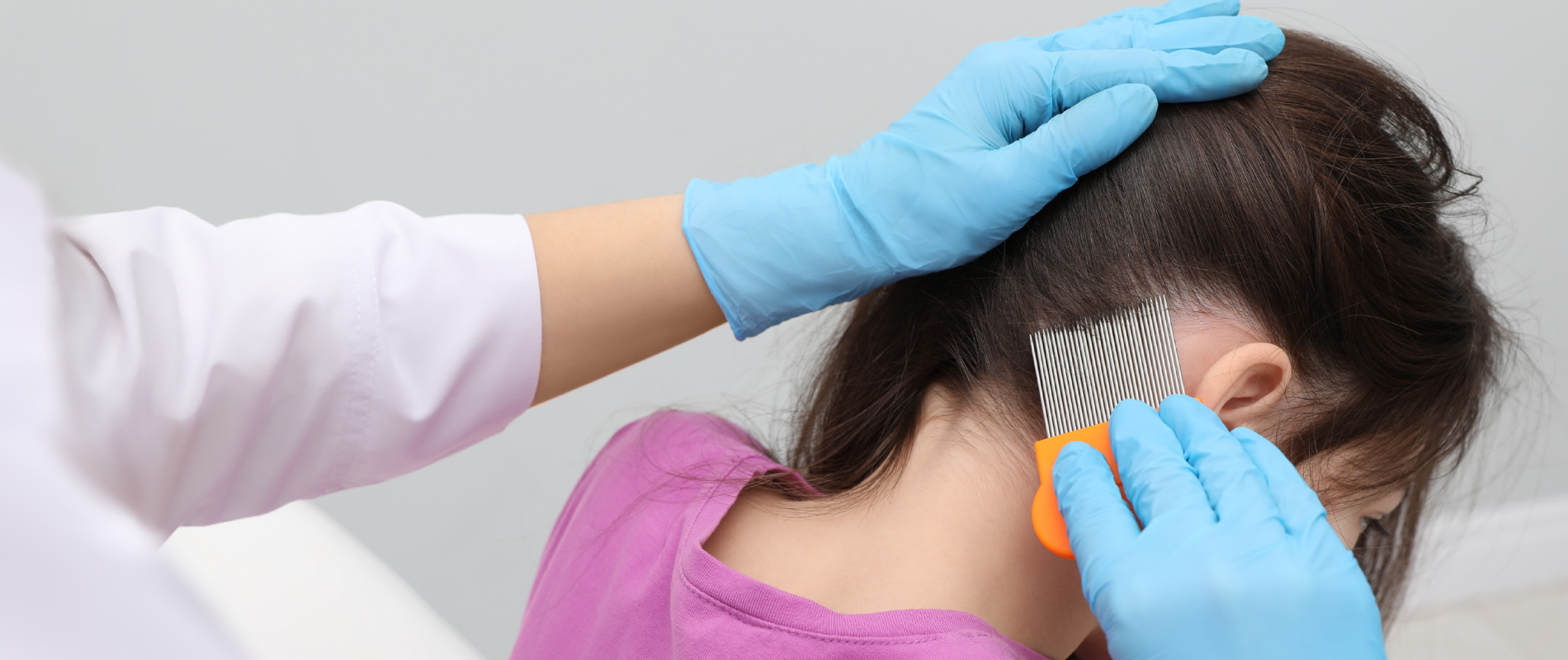
Diagnosis requires the examination of the scalp and hair. Special “nit combs” with fine teeth are available to help with this. Before using the nit-comb, use a regular comb or brush to remove tangles and this can be done with dry or wet hair. If wet, apply a conditioner to make it easier to use the nit-comb. Place the fine-toothed comb at the top of the head touching the scalp and pull the comb through the hair from roots to the end. After each stroke, carefully examine the comb for lice or eggs. Comb the entire head at least twice.
Lice can be more difficult to see than nits. A doctor or nurse can use a special lamp (ultraviolet light) which causes nits to glow a pale blue color. There are also head lice clinics and portable services which can be called to help with diagnosis and treatment.
Finding head lice can be very upsetting for children and parents, so it is important to keep in mind:
- Head lice are not caused by being dirty or sick.
- Proper treatment of head lice will get rid of them.
- Head lice do not cause any long-term health problems.
Treatment of head lice:
There are over-the-counter treatments as well as prescription treatments. Examine family members and close contacts and treat them, if needed. For children under the age of two years, contact a Healthcare Provider (doctor or nurse).
The over-the-counter treatment is Nix (permethrin) and RID, Pronto, LiceMD and A-200 (containing pyrethrins-piperonyl butoxide).
Prescription topical products contain malathion, benzyl alcohol, Spinosad and topical ivermectin. Oral ivermectin may be prescribed for people with lice resistant to the topical treatments.
Avoid the use of a hair conditioner or shampoo–conditioner before application of the insecticide.
A second treatment is needed with permethrin, pyrethrin and benzyl alcohol seven to nine days after the first treatment.
Wet combing is an option for treating very young children or if you want to avoid using insecticides, however this is time consuming and must be repeated multiple times over a few weeks. For this method, wet the hair and add a lubricant such as a hair conditioner, cream rinse, vinegar or olive oil. Use an appropriate fine-toothed comb. The combing sessions should take 15 to 30 minutes depending on the thickness and length of the hair. Comb every three to four days for two weeks after you find any large adult lice.
Clothing, bedding and towels used within 48 hours prior to treatment should be washed in hot water and dried in a drier on the hot setting. Dry cleaning is also effective. Use a vacuum to clean carpets and furniture, although head lice spread on those objects is less likely. Items that cannot be washed or vacuumed can be sealed is a plastic bag for two weeks. You do not need to have your home or belongings sprayed with insecticide.
More information is available at:
- National Library of Medicine, also available in Spanish
- Center for Disease Control and Prevention
- The Nemours Foundation

Stay Connected
Sign up to get interesting news and updates delivered to your inbox.